

How to Choose a Warehouse Transport Robot by Task
A practical framework for using pallet, cart, tote, case, and stacking workflows to identify candidate families worth validating—before comparing models or specifications.
Quick Answer
Choose a warehouse transport robot by defining the movement task before comparing products.
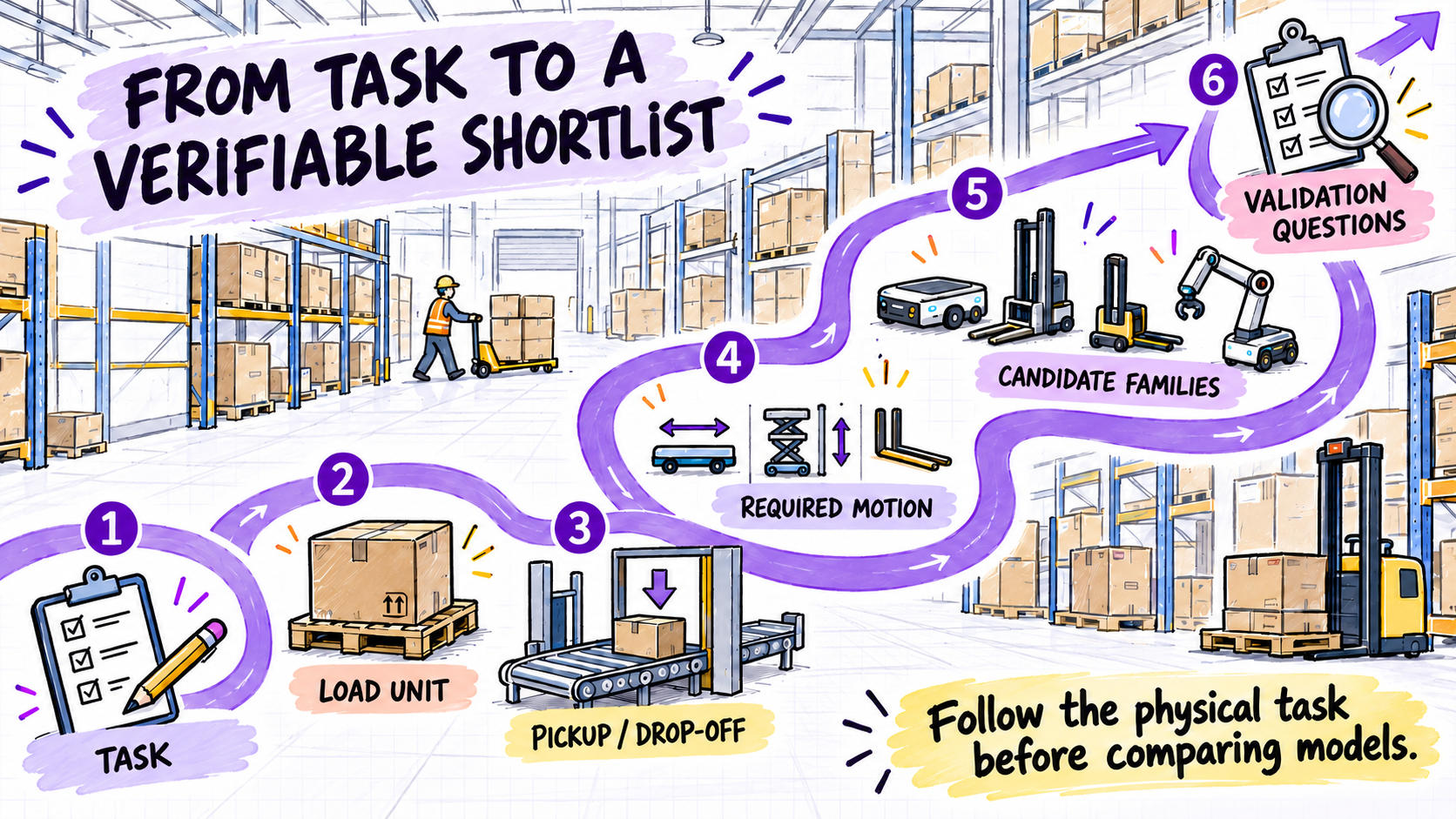
Start with six questions:
- What load unit is moving: a pallet, cart, rack, case, tote, or loose item?
- Where is it collected and delivered: the floor, a stand, a conveyor, a workstation, or a storage location?
- Must the robot only travel horizontally, or must it also lift, stack, reach, or transfer the load?
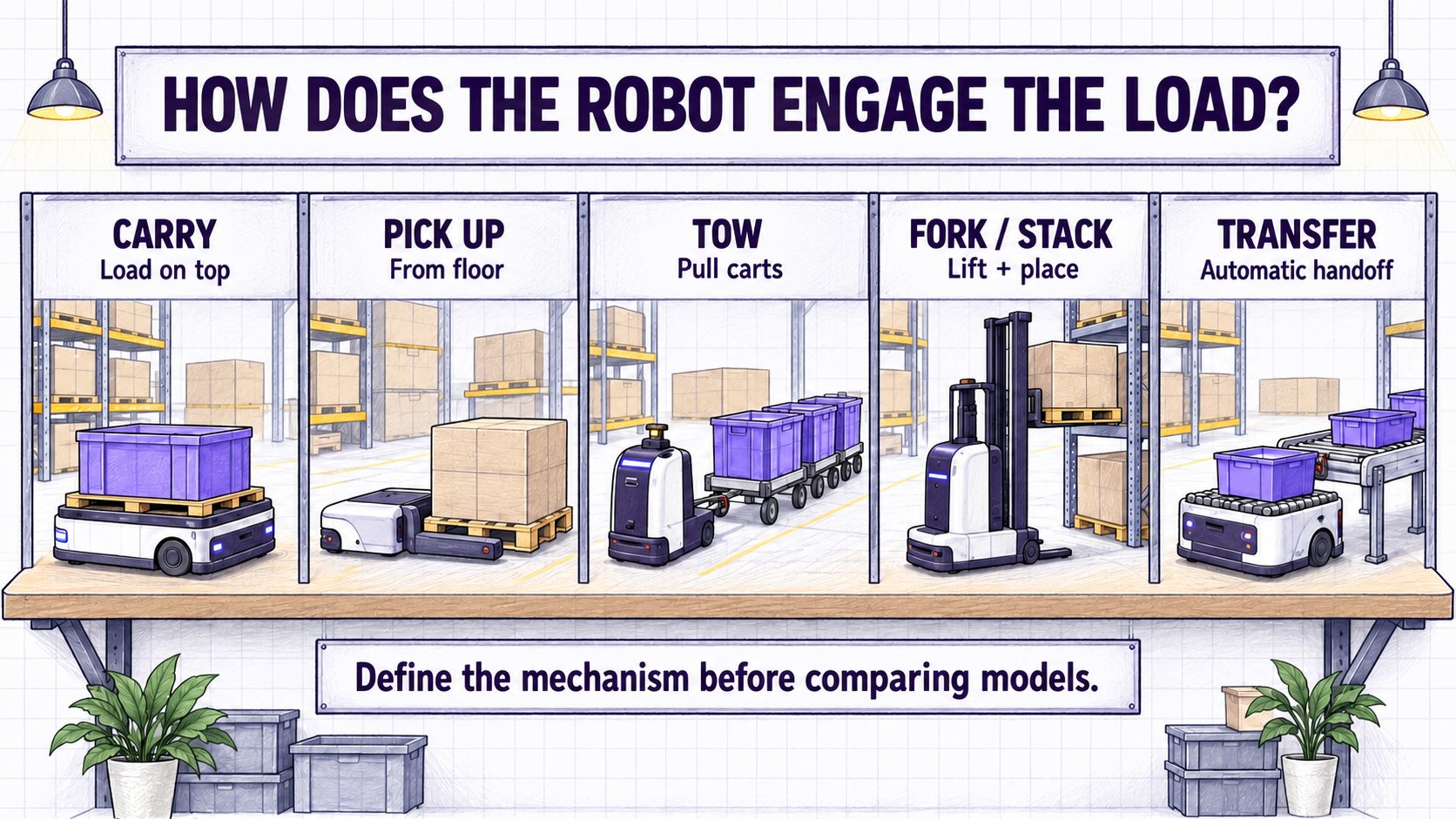
- How is the load engaged: carried on top, picked from below, pulled, lifted with forks, or transferred automatically?
- What route, traffic, space, floor, and throughput conditions must the system handle?
- What evidence will be required before the concept can be approved?
These answers identify candidate families worth validating, not a final product. Navigation approach, safety design, fleet software, integration, performance, and site validation still need to be assessed separately.
Separate Navigation Approach From Load-Handling Form
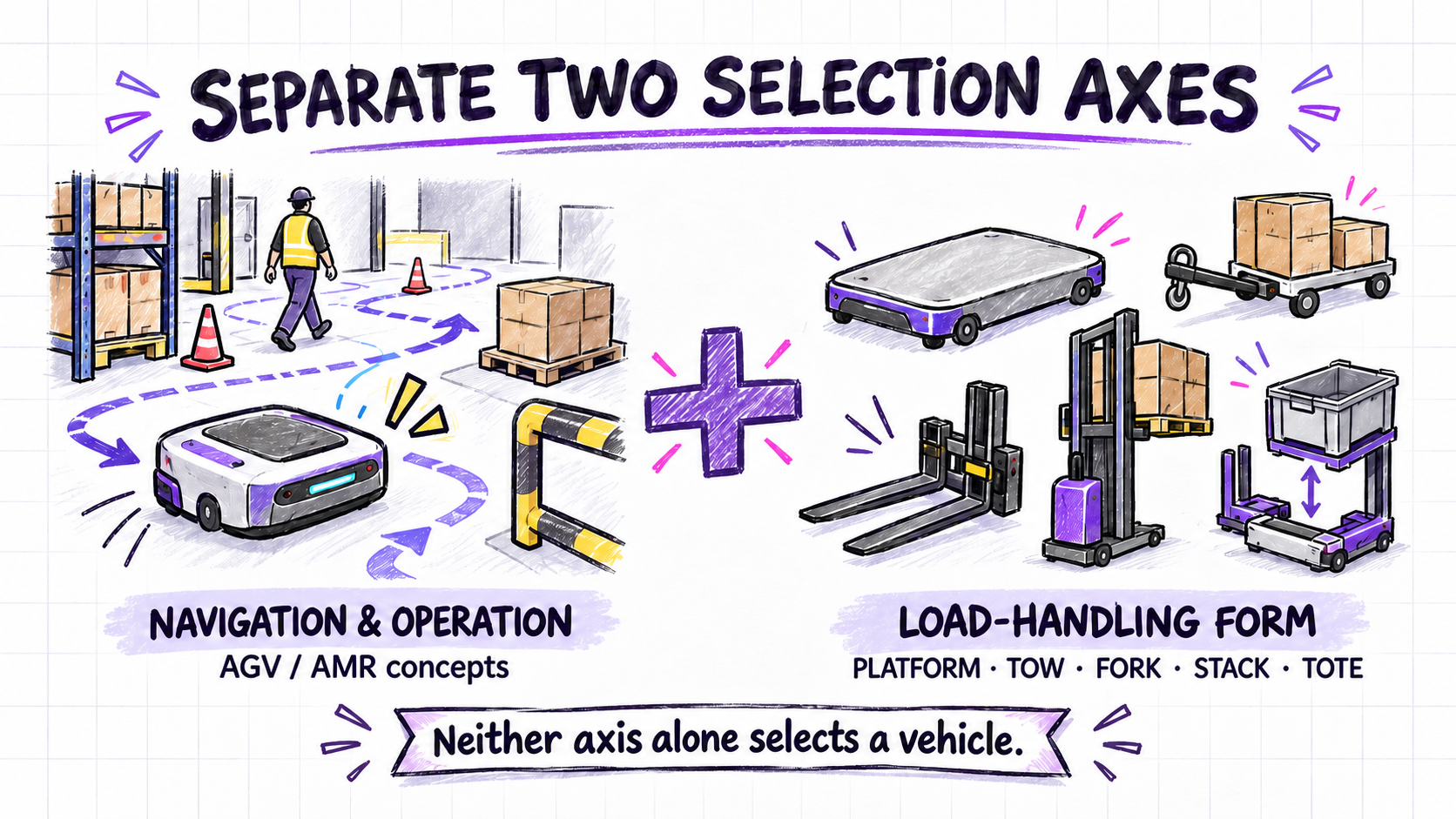
Warehouse robot discussions often mix two different questions.
The first is how the vehicle navigates and operates in traffic. This guide treats AGV and AMR as terms on that navigation and operating-approach axis. If this is the decision you are making, begin with BotOnly’s AGV vs AMR guide.
The second is how the vehicle engages and moves the load. Examples include:
- A deck or platform vehicle that carries a load on top
- A low-lift vehicle that collects a pallet near floor level
- A tugger or tow tractor that pulls one or more wheeled carts
- An under-load lifting or rotating AMR for a compatible cart, rack, or load carrier, when that form is represented in the current BotOnly source set
- A fork-style vehicle that lifts and transports pallets
- A stacker or reach-type vehicle that places pallets into storage
- A CTU or other verified tote-handling AMR that moves compatible totes between storage or transfer locations and a workstation
These are not mutually exclusive with AGV or AMR. A towing vehicle, pallet mover, or fork-style robot may use different navigation and traffic-management approaches. Treating every label as one flat list makes the shortlist less accurate.
The distinction is visible in official portfolios, although each supplier uses its own taxonomy. MiR pairs mobile robots with hook, shelf-lift, and pallet-lift applications. (MiR) ABB groups tug, mover, and stack vehicles. (ABB) Seegrid presents lift products separately from its tow tractor. (Seegrid)
Define Six Inputs Before Comparing Candidate Families
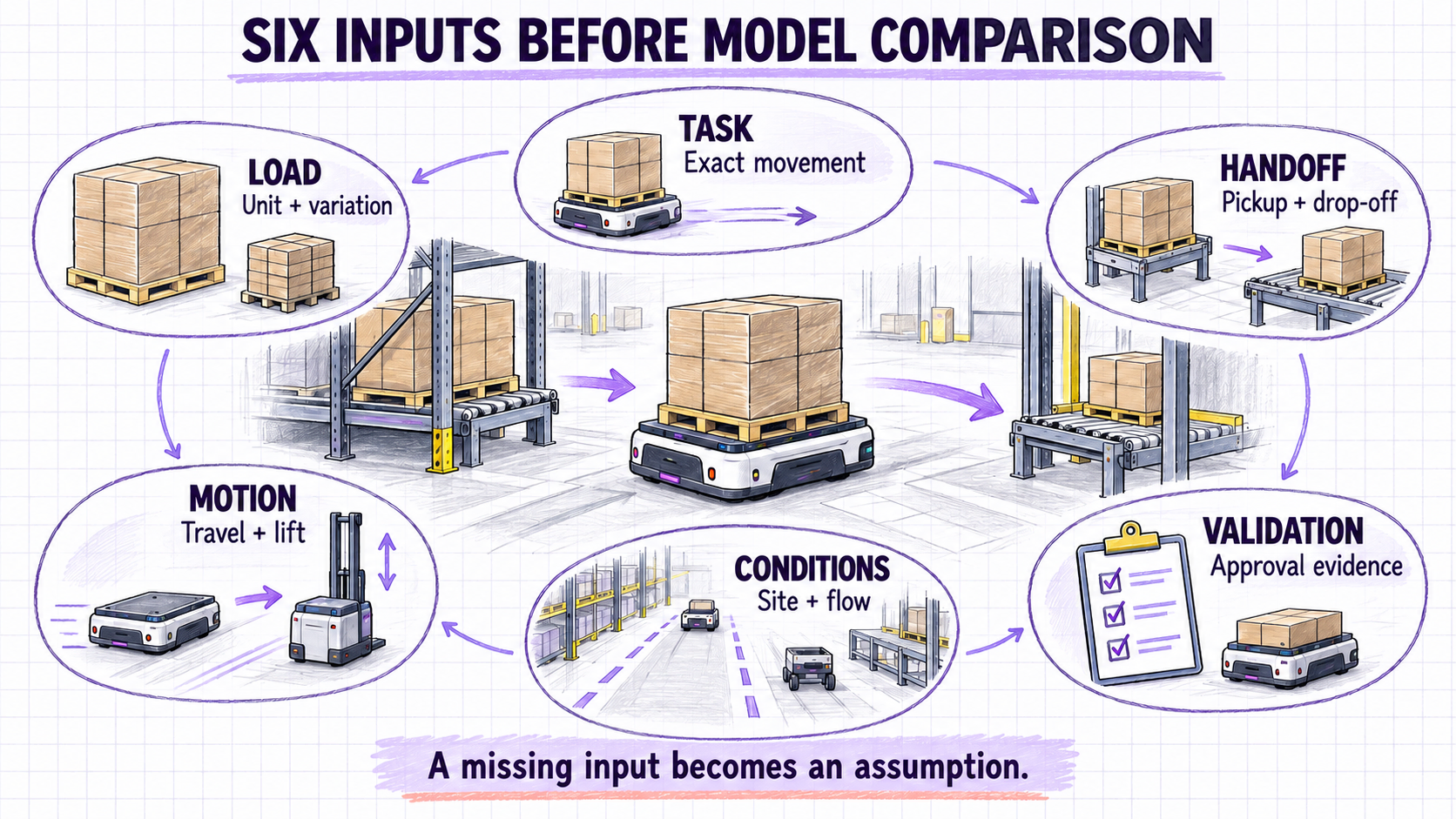
1. Task
Describe the movement in operational terms.
“Move materials” is too broad. “Collect a wrapped pallet from a marked floor position and deliver it to a production-side buffer” is useful. So is “pull four identical carts on a repeating milk run” or “move totes between a conveyor and manual inspection stations.”
OTTO’s workflow guidance similarly starts with the current movement between people, automation equipment, racks, and floor locations before evaluating an AMR solution. (OTTO Motors)
2. Load unit
Record the real load, including:
- Unit type
- Minimum and maximum weight
- Dimensions and overhang
- Center of gravity and stability
- Pallet or cart construction
- Wrapping, straps, lids, or loose contents
- Whether loads vary by SKU, shift, or season
A nominal payload figure is not enough. The same weight can behave differently on a rigid pallet, a damaged pallet, a tall cart, or a partly filled tote.
3. Pickup and drop-off
Identify the physical handoff at both ends:
- Floor position
- Pallet stand
- Wheeled cart
- Conveyor
- Rack
- Machine
- Workstation
- Manual staging area
Also record the height, alignment tolerance, approach direction, available clearance, and whether a person or control system confirms that the location is ready.
4. Horizontal and vertical action
Every candidate must satisfy the required motion:
- Horizontal travel only
- Horizontal travel plus top transfer
- Floor pickup
- Fork entry and lift
- Low-level stacking
- Rack storage or retrieval
- High reach
- Precise alignment with a conveyor or machine
A robot that can transport a pallet is not automatically able to collect that pallet from the floor or place it into a rack.
5. Operating conditions
Document route length, aisle width, intersections, manual traffic, doors, gradients, floor transitions, charging opportunities, operating hours, and current and peak flow.
OTTO’s official selection guidance asks for details such as payload dimensions, pallet type, pickup and drop-off height, throughput, manual traffic, ramps, slopes, and Wi-Fi conditions. These are useful discovery inputs, although the final validation requirements will vary by system. (OTTO Motors)
6. Validation standard
Decide what evidence will move a candidate from “possible” to “approved.” This may include load tests, docking repeatability, route observations, peak-flow simulation, exception handling, system-interface tests, safety review, and acceptance criteria.
Task-to-Robot Decision Matrix
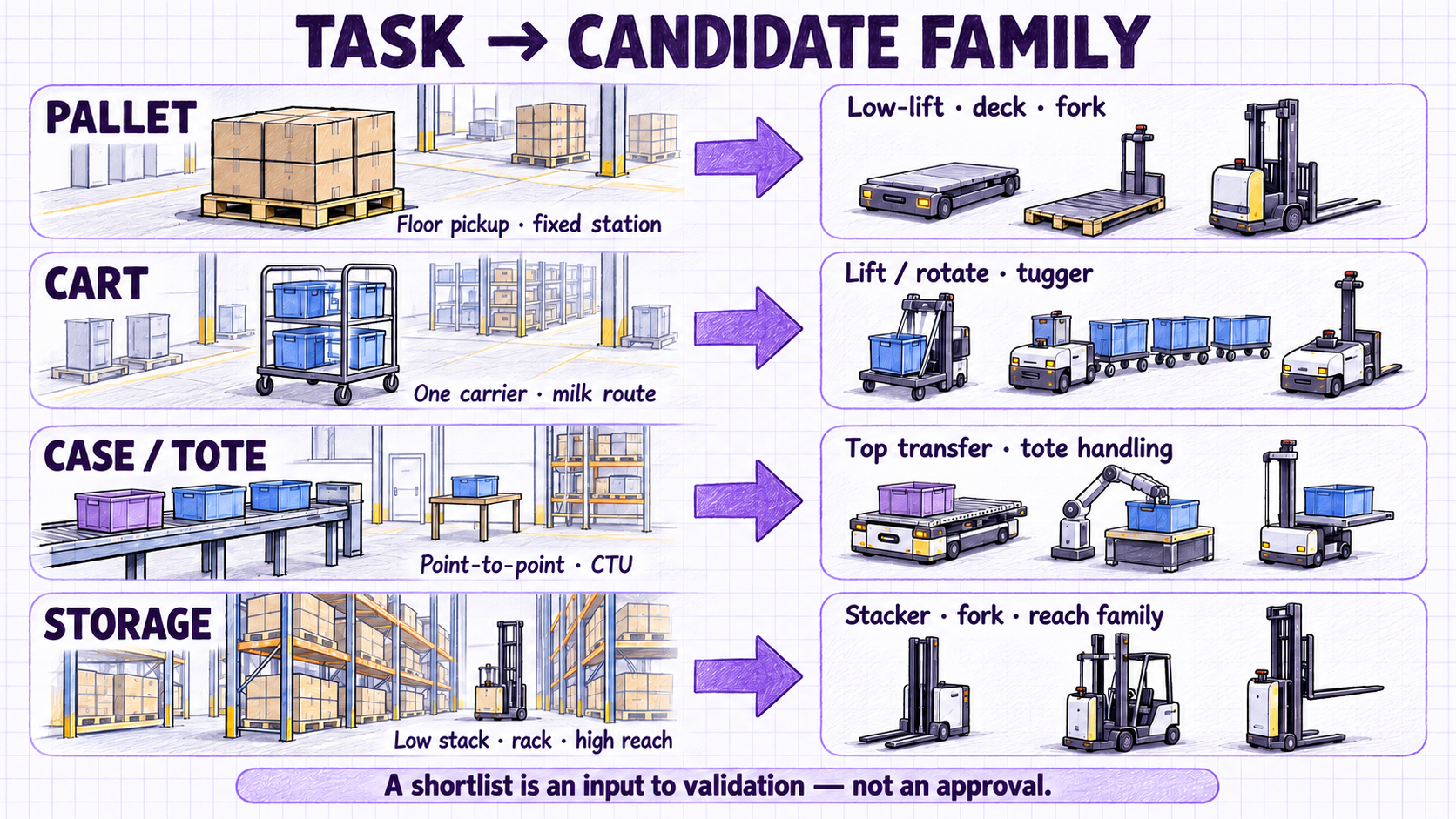
Use the matrix to create a shortlist. A row may produce more than one candidate because facility constraints, load design, throughput, and integration can change the result.
| Task | Load unit | Pickup / drop-off | Horizontal / vertical action | Candidate robot family | Validation questions |
|---|---|---|---|---|---|
| Move pallets between floor positions | Palletized load | Floor to floor or floor to buffer | Horizontal travel plus floor pickup and low lift | Low-lift pallet transporter; automated pallet truck; fork-style mobile robot | Can the vehicle enter the pallet correctly? Are pallet openings, bottom boards, wrapping, overhang, floor clearance, and load stability consistent? |
| Move pallets between fixed stations | Palletized load | Stand, conveyor, wrapper, or fixed transfer station | Horizontal travel plus automatic transfer or controlled lift | Platform or deck pallet mover with transfer mechanism; fork-style pallet mover | Are station height, approach direction, controls, sensing, alignment tolerance, and load-ready signals defined? |
| Run a milk route or move cart trains | One or more wheeled carts | Cart staging point to repeated stops | Horizontal towing | Tugger or tow tractor | What is the total train weight and length? How are carts coupled? Can the train turn, stop, reverse, and pass safely on the route? |
| Move one compatible cart, rack, or load carrier | Wheeled cart, rack, or compatible carrier | Staging position to workstation | Horizontal travel with docking or under-load lifting/rotation | Under-load lifting or rotating AMR verified in the current BotOnly source set | Is every carrier mechanically compatible? Are wheel condition, underside clearance, docking access, alignment, and load retention controlled? |
| Deliver cases or totes point to point | Case, tote, bin, or tray | Workstation, conveyor, rack face, or staging position | Horizontal travel; possibly top transfer | Tote/case transport robot; conveyor-top or lift-top mobile robot | Must transfer be manual or automatic? Are tote dimensions standardized? How are occupancy, jams, orientation, and destination readiness detected? |
| Move compatible totes from storage or transfer locations to a picking or inspection station | Standardized tote or bin | Tote storage or transfer location to workstation | Tote retrieval or transfer plus horizontal transport | CTU tote-handling AMR or another tote-handling form verified in the current BotOnly source set | Are tote dimensions and condition standardized? Are storage and workstation interfaces compatible? How are occupancy, jams, orientation, destination readiness, replenishment, and exceptions handled? |
| Stack pallets or place them into storage | Palletized load | Floor or stand to low- or medium-level rack | Horizontal travel plus lift and placement | Autonomous stacker; fork-style mobile robot | What are the lift height, residual capacity, rack geometry, pallet orientation, clearance, load stability, and placement tolerance? |
| Store or retrieve pallets in high or narrow aisles | Palletized load | Rack location at height | Travel plus high reach or specialized aisle operation | Reach-type, turret-type, or other specialized autonomous lift vehicle | Is the aisle and rack designed for the vehicle? What guidance method, floor-flatness tolerance, clearance, applicable fire-safety and egress requirements, capacity at height, and exception controls apply? |
| Feed machines, cells, or conveyors | Pallet, rack, cart, case, or tote | Equipment interface to equipment interface | Horizontal travel plus precise docking or transfer | Platform, conveyor-top, lift-top, tugger, or fork-style family selected to match the load | Who controls the handshake? What signals confirm ready, occupied, complete, fault, and recovery states? Can the robot approach safely while people use the area? |
| Combine long transport with storage placement | Usually a pallet | Receiving or production area to end of aisle, then rack | Horizontal travel plus a separate vertical storage action | One vehicle capable of both actions, or separate horizontal transport and storage vehicles | Is combining the actions efficient, or does it create idle time and a bottleneck? Where will custody and control transfer between vehicles? |
The last row is important. A single material flow does not always require a single robot type. BALYO’s inbound-to-end-of-aisle example illustrates how horizontal pallet transport and storage handling can be treated as connected but distinct operations. (BALYO)
Compare Candidate Families by Physical Task
Pallet transport
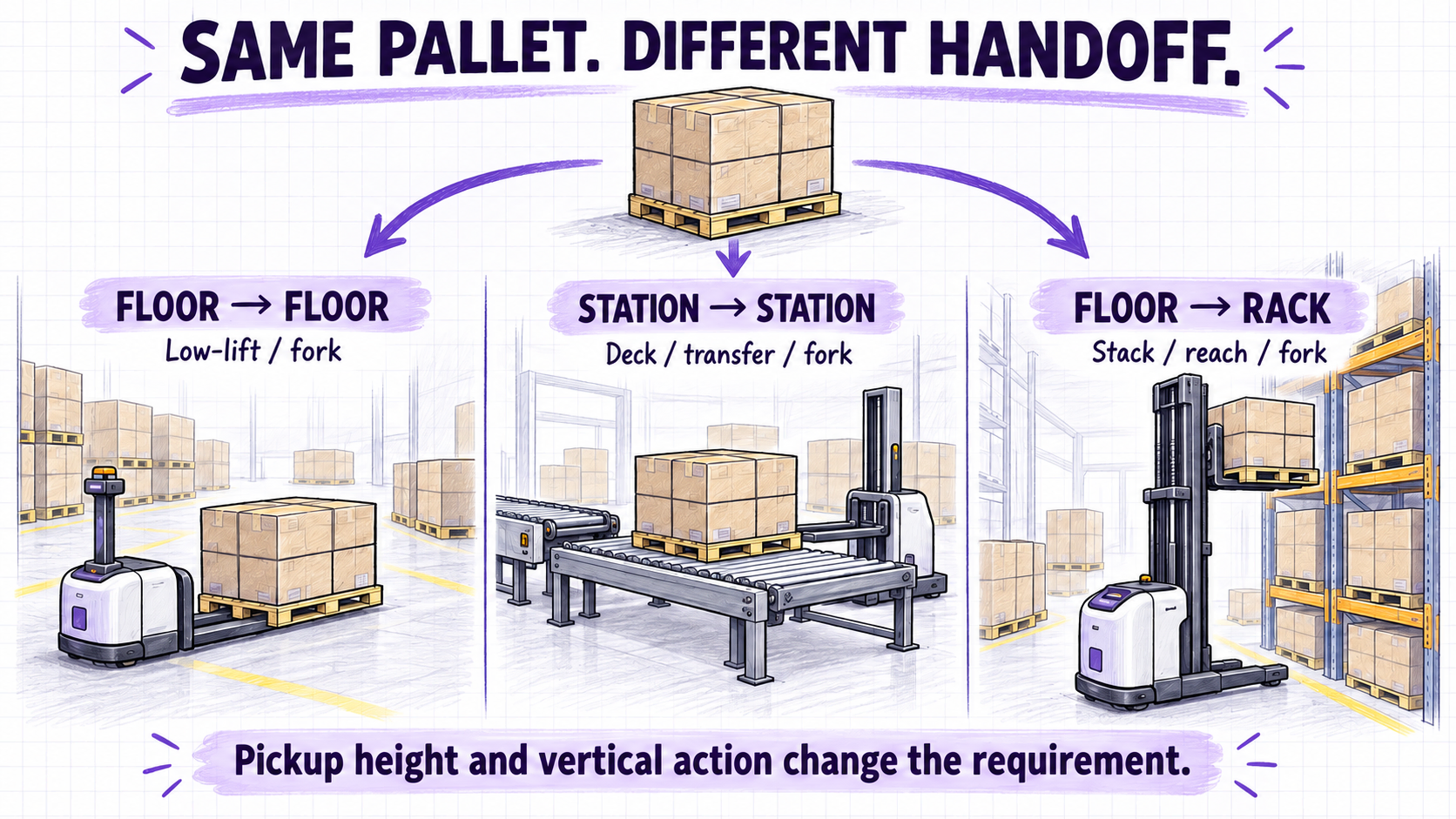
First determine how the pallet will be collected and delivered.
For floor-to-floor movement, the candidate needs a compatible floor-pickup method. For a pallet that remains on a stand or transfer station, a deck, conveyor-top, lift-top, or fork-style approach may be possible depending on the interface.
Do not stop at payload. Verify pallet construction, entry direction, damaged-board policy, load overhang, wrapping, ground clearance, pickup height, and the space required to approach and exit.
If the destination is a rack location, the task is no longer horizontal pallet transport alone. It includes vertical placement, rack clearance, and capacity at the required height.
Cart and trolley towing
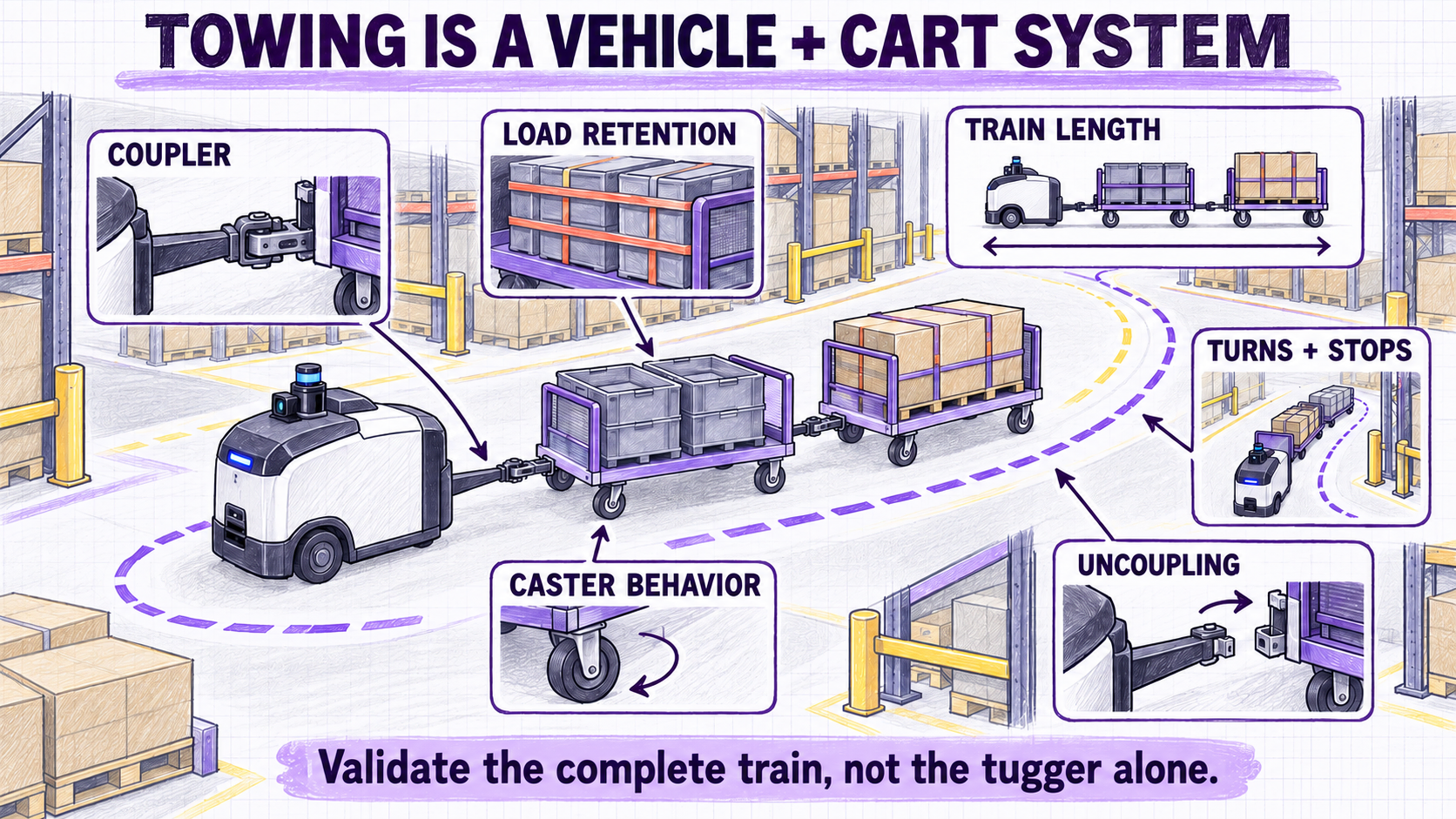
Towing is often a strong candidate when the existing process already uses wheeled carts, especially for repeated routes, line supply, replenishment, or return flows. ABB describes towing mobile robots as vehicles that pull one or more trolleys. (ABB) On its own Tow Tractor product card, Seegrid lists long-haul cart train tugging, parts-to-line, replenishment, putaway, cross-docking, and dunnage/trash removal as key applications. (Seegrid)
The cart system is part of the automation. Couplers, caster behavior, cart dimensions, load retention, train length, turning radius, stop distance, and manual uncoupling all affect feasibility.
For one compatible cart, rack, or load carrier, an under-load lifting or rotating AMR may reduce coupling work when that form is present in the current BotOnly source set. It still requires mechanical standardization, verified underside clearance, and repeatable docking access.
Pallet stacking and rack handling
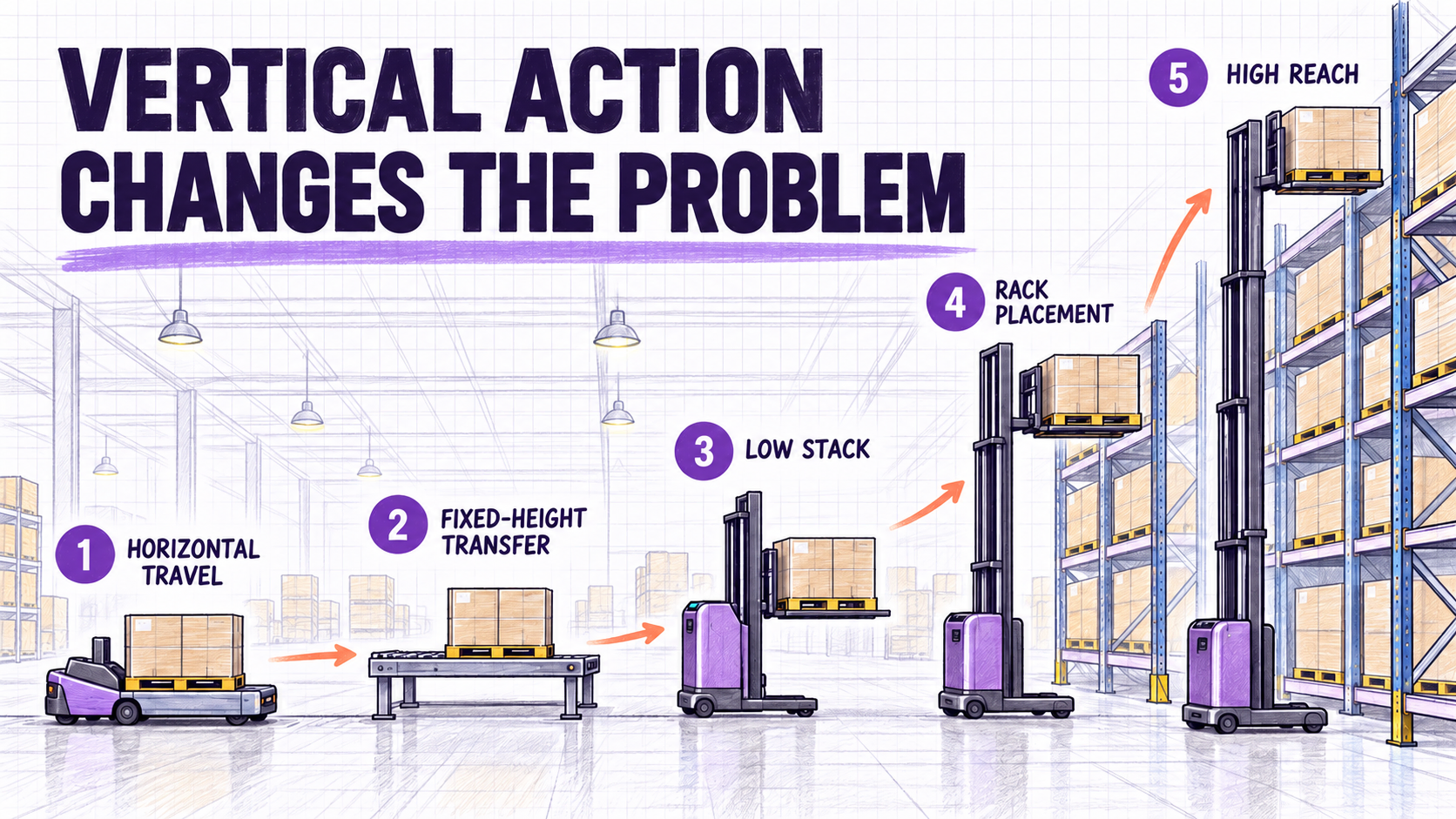
A stacker or autonomous forklift family becomes relevant when the robot must lift a pallet above a transfer height, place it into storage, or retrieve it from a rack.
The required height alone does not settle the choice. Capacity can change with lift height and load center, and the vehicle must work within the aisle, rack, floor, and clearance conditions. Low-level stacking, general rack handling, and high narrow-aisle storage should therefore be treated as different validation problems.
Case and tote movement
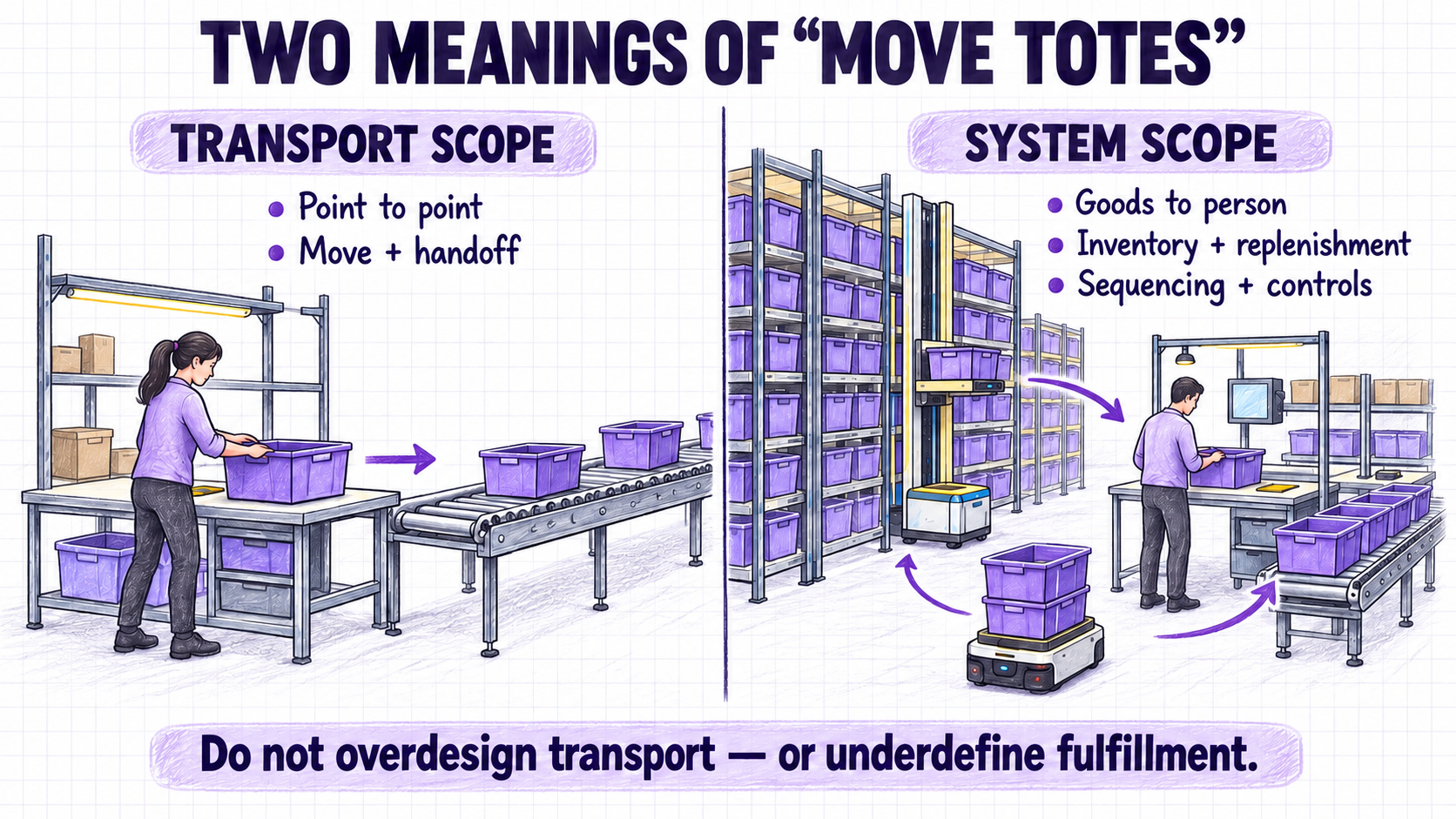
“Move totes” can describe two very different scopes.
The first is point-to-point transport: a standardized tote or case travels between workstations, conveyors, inspection points, or production cells. A top-transfer or manually loaded transport robot may be sufficient.
A verified CTU or tote-handling robot may support tote movement between compatible storage or transfer locations and a workstation. A broader goods-to-person system can also include shelves, racks, pallets, inventory logic, replenishment, sequencing, and pick stations, but this guide does not present those unverified system forms as BotOnly candidate products.
Industry suppliers use different system taxonomies. Dematic separates Bin-to-Picker, Shelf-to-Picker, Pallet-to-Picker, and AMR Transport in its own portfolio, while Geek+ presents Shelf-to-Person, Tote-to-Person, Pallet-to-Person, and Material Transport as separate solutions or modules. These examples establish the boundary between simple transport and broader fulfillment design; they are not copied into the BotOnly candidate list unless a matching BotOnly product source is verified.
This boundary prevents a simple transport requirement from being overdesigned, prevents a fulfillment requirement from being reduced to vehicle travel alone, and keeps the BotOnly shortlist limited to verified product forms.
Apply Facility and Flow Filters
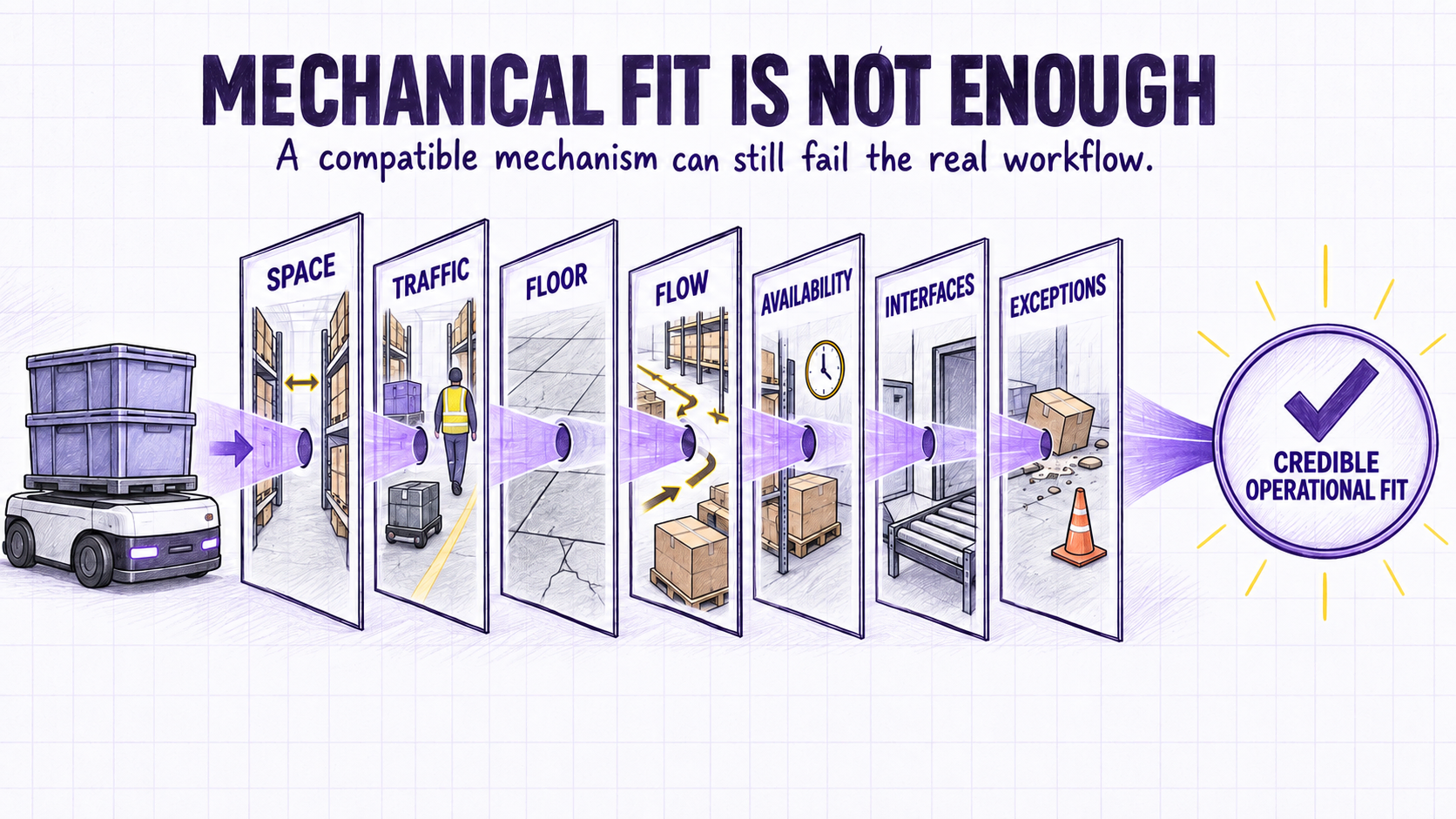
A mechanically compatible robot can still be the wrong operational choice.
Filter each candidate against:
- Space: aisle width, turns, staging areas, queues, passing points, and docking clearance
- Traffic: pedestrians, forklifts, intersections, blind corners, shift changes, and shared work zones
- Floor and environment: gradients, joints, thresholds, debris, temperature, moisture, and lighting or sensing conditions
- Flow: average rate, peak rate, variability, empty return trips, waiting, and blocked destinations
- Availability: operating hours, charging windows, maintenance access, and recovery procedures
- Interfaces: doors, elevators, conveyors, machines, call buttons, traffic controls, and business systems
- Exceptions: damaged loads, missing carts, occupied stations, misplaced pallets, spills, network loss, and manual overrides
Do not convert a travel speed from a datasheet directly into throughput. Real flow also includes pickup, alignment, loading, unloading, waiting, charging, traffic interaction, exceptions, and empty movement.
Turn Candidate Families Into a Verifiable Shortlist
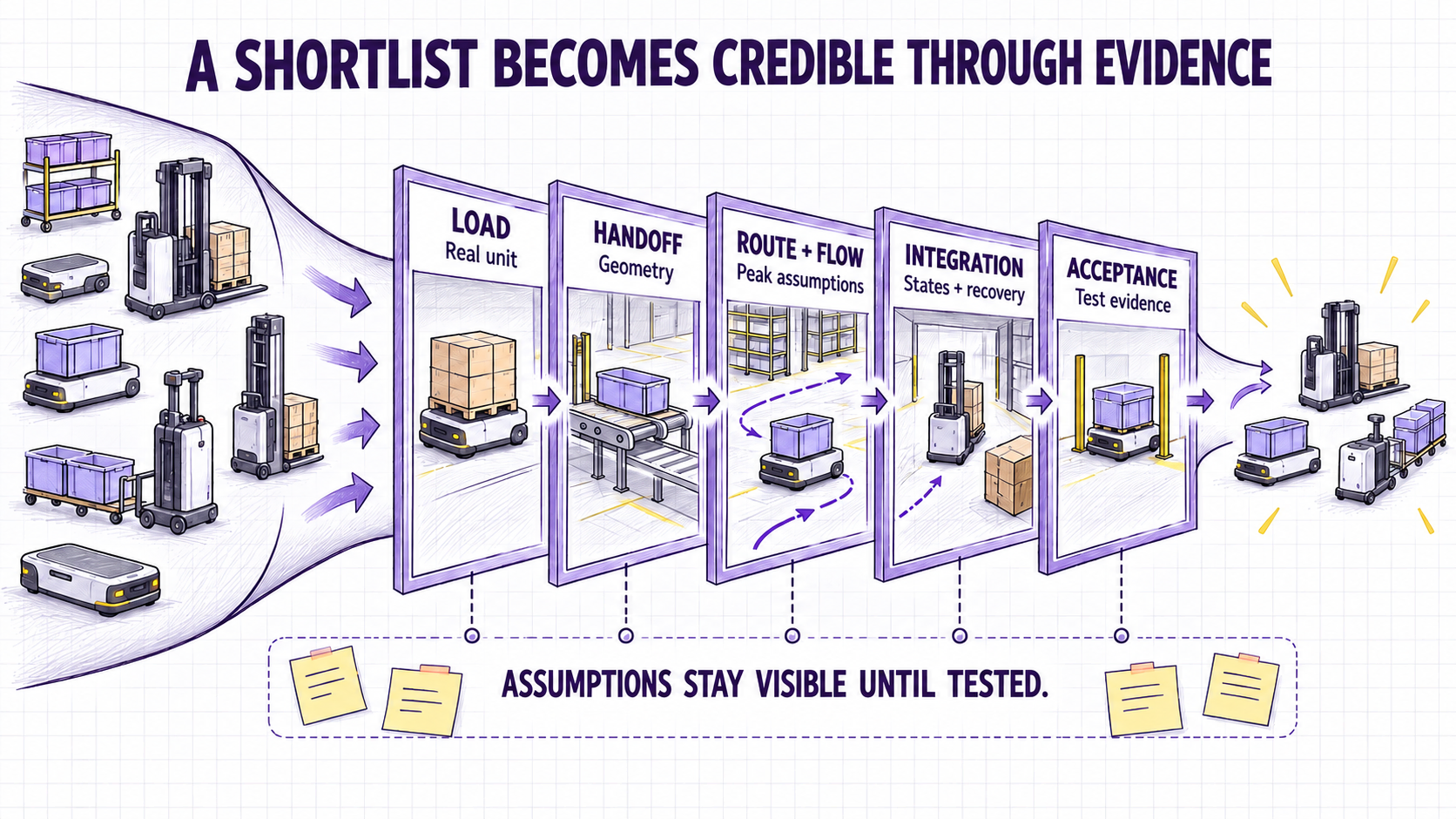
For every shortlisted family, ask suppliers or integrators to respond to the same task definition and evidence request.
Load evidence
- Supported load range and center-of-gravity assumptions
- Load dimensions, overhang, stability, and retention
- Pallet, cart, tote, or rack compatibility
- Required condition and dimensional tolerance of the load carrier
- Capacity at the actual lift height, where relevant
Handoff evidence
- Pickup and drop-off heights
- Required clearance and approach direction
- Docking and placement tolerance
- Station sensing and load-ready logic
- Recovery when a station is occupied, misaligned, or unavailable
Route and flow evidence
- Turning and stopping envelope with the real load
- Behavior at intersections and in mixed traffic
- Treatment of narrow points, doors, slopes, and floor transitions
- Fleet size and throughput assumptions
- Charging and peak-period strategy
- Queueing, blocked destination, and empty-return logic
Integration and operating evidence
- Interface ownership
- Command, status, fault, and recovery states
- Manual operating and override procedures
- Safety review scope
- Maintenance and support responsibilities
- Test plan and acceptance criteria
Require assumptions to be visible. A throughput estimate without route, dwell, traffic, charging, and exception assumptions is not yet a comparable result.
Common Selection Mistakes
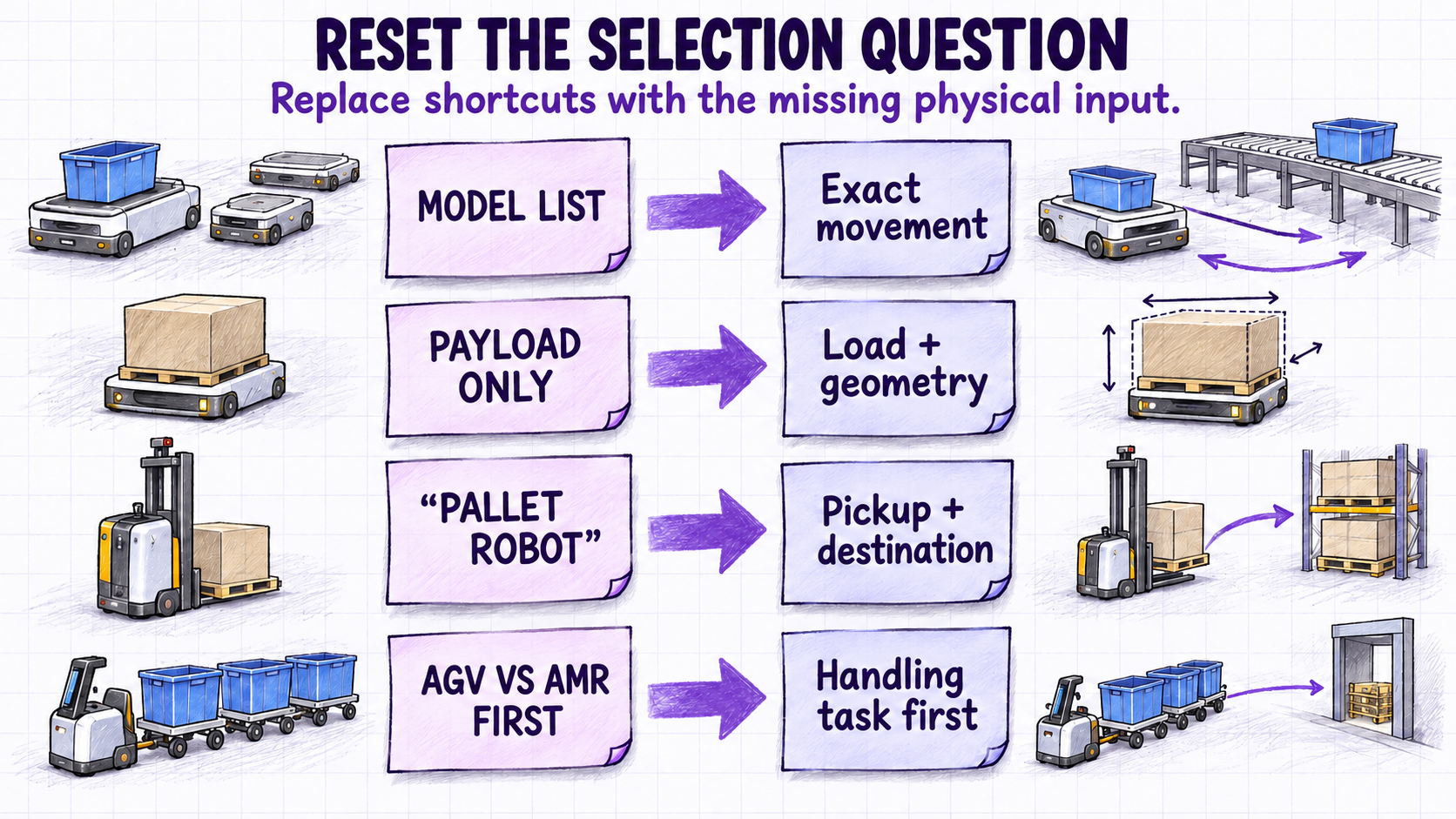
Starting with a model list
A product list hides the physical task. Start with the movement, load, handoff, and required action.
Using payload as the only filter
Weight does not capture load center, stability, carrier condition, overhang, lift height, or transfer geometry.
Calling every pallet movement “forklift automation”
Some pallets move between fixed stations or remain on transfer stands. Others require true floor pickup or rack placement. Those tasks do not have identical mechanical requirements.
Treating tote transport as goods-to-person automation
Point-to-point tote movement and inventory presentation solve different operational problems.
Assuming one vehicle must perform every step
Separating horizontal travel from vertical storage may reduce bottlenecks in some workflows. In others, one vehicle may be simpler. Compare the complete flow.
Comparing navigation labels before defining the load task
AGV versus AMR matters, but it does not determine whether the vehicle should carry, tow, fork, stack, or transfer the load.
FAQ
Can one workflow use more than one robot family?
Yes. A long horizontal move and a specialized rack-placement step may be assigned to different vehicles. Compare the transfer point, queueing, control ownership, recovery process, and utilization of both concepts against a single-vehicle alternative.
What if pallets, carts, or totes are not standardized?
Measure the actual range of dimensions, condition, load center, overhang, caster behavior, and pickup access. Then decide whether the process should standardize the load carrier, define a supported operating envelope, or route exceptions to a manual process. Do not assume a maximum payload rating covers mechanical variation.
When does a transport task become a broader automation-system decision?
If the scope includes storage access, inventory location, order sequencing, replenishment, pick-station design, or orchestration across multiple technologies, evaluate it as a system rather than as a vehicle movement alone. The vehicle family remains one design element within that larger workflow.
Sources
- OTTO Motors — AMA: Which material handling workflows are autonomous mobile robots best suited to automate?
- OTTO Motors — The 5 stages of AMR selection: A complete overview
- MiR — Autonomous Mobile Robot Applications
- Seegrid — Autonomous Mobile Robots (AMR) Solutions
- ABB — Mobile Robots
- ABB — Towing AMRs: The ideal solution for the transport of loads on trolleys
- Dematic — Autonomous Mobile Robots (AMRs)
- Geek+ — Automation 201: Choosing the Right Robotic Automation
- Geek+ — Geek+ | Robotics Solutions for Warehouse & Logistics Automation
- BALYO — Inbound to End of Aisle
- BALYO — AGV & AMR: Automated Guided Vehicles & Robots
Ready to evaluate warehouse automation?
Use this guide’s workflow, load, route and site inputs to compare AGVs, AMRs, autonomous forklifts and stackers.