

AGV vs AMR: Key Differences and How to Choose
Compare AGVs and AMRs by navigation, infrastructure, flexibility, cost, safety, and scalability—then use a practical framework to choose the right approach for your operation.
Quick answer
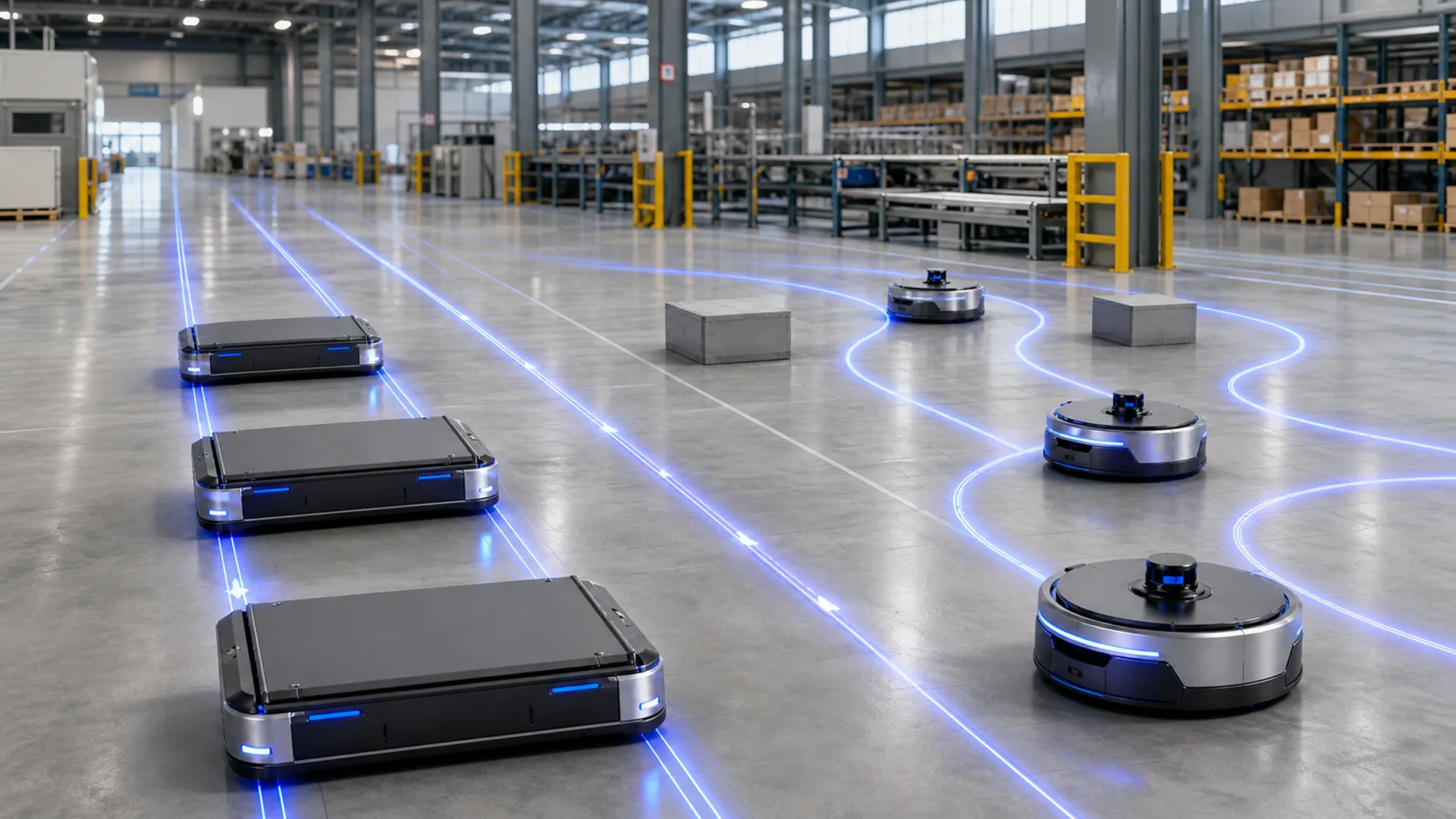
An AGV typically follows a predefined route or virtual path and is well suited to stable, repeatable material flows. An AMR typically uses onboard perception, mapping, and path planning to choose a route within an allowed operating area, which can make it better suited to changing layouts, shared traffic, or frequent obstacles—provided the proposed system has validated safety functions, traffic rules, and a site-specific risk assessment.
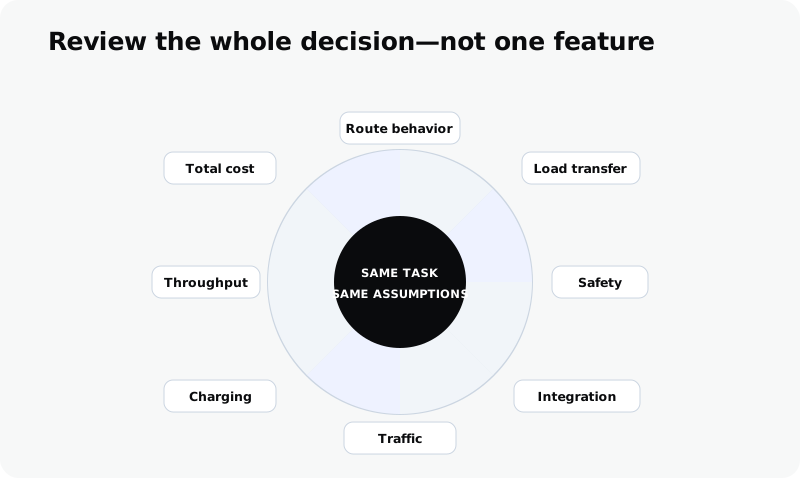
Neither is automatically better. A predictable point-to-point task may favor an AGV, while a dynamic workflow may favor an AMR. Payload, transfer method, traffic, safety, integration, charging, throughput, and total cost must still be checked at the system level.
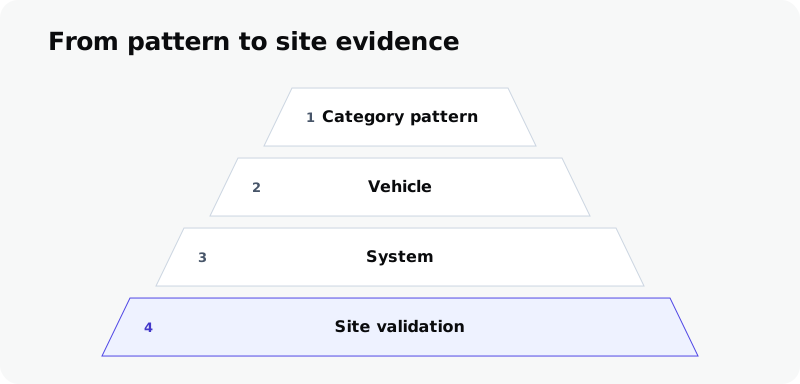
To compare AGV and AMR systems responsibly, use the same task definition, site constraints, risk criteria, and cost scope for both options.
Whether the question is framed as AGV vs AMR or AMR vs AGV, the decision process should start with the task and operating environment rather than the category label.
Automated guided vehicles and autonomous mobile robots can both move materials without an onboard driver, but they do not make routing decisions in the same way. The practical difference is not simply “old technology versus new technology.” It is how much route autonomy the system has, what infrastructure it needs, how it responds to change, and how well those characteristics fit a specific operation.

AGV vs AMR at a glance
| Comparison area | Typical AGV approach | Typical AMR approach | What to verify |
|---|---|---|---|
| Route logic | Follows a predefined path or route network | Plans or selects routes within an approved operating area | How routes are created, changed, and governed |
| Navigation | May use wire, magnetic tape, QR codes, reflectors, laser, vision, or natural features | Commonly uses maps, onboard sensors, localization, and path planning | The actual navigation stack of the proposed model |
| Obstacle response | Often slows, stops, or waits when the route is blocked | May evaluate an alternative route when rules and safe clearance allow | Whether rerouting is supported in the real environment |
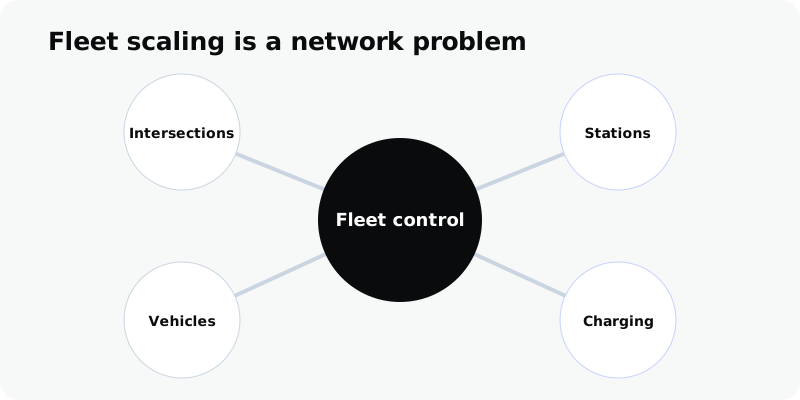
| Physical infrastructure | May require physical guidance or fixed route infrastructure, depending on the design | Often needs less physical guidance, but still needs maps, networks, stations, charging, and traffic rules | Complete site-preparation scope, not just floor markings |
| Layout changes | Route changes may require physical and software work | Route or zone changes are often software-led | Validation, remapping, and safety work after a change |
| Flow predictability | Strong fit for stable, repetitive, controlled routes | Strong fit for variable tasks and dynamic routing | Task variation, peak demand, and exception frequency |
| Scaling | Additional vehicles require route, traffic, charging, and fleet analysis | Additional vehicles still require traffic, charging, and fleet analysis | Congestion, deadlock, queueing, bandwidth, and dispatching |
| Docking and load transfer | Can support precise, repeatable handoffs when the vehicle, station, and controls are engineered for the task | Can also support precise handoffs, but route autonomy alone does not determine docking performance | Positioning tolerance, alignment method, load geometry, transfer mechanism, and acceptance test |
| Cost structure | Vehicle, guidance, installation, controls, integration, maintenance, and future route changes | Vehicle, mapping, fleet software, integration, network, charging, maintenance, and future expansion | Total cost of ownership under the same project scope |
This AGV and AMR comparison describes common system patterns, not universal rules. Advanced AGVs may use laser or natural-feature localization, and an AMR still operates within configured maps, zones, traffic rules, and safety constraints.
What is an AGV?
An automated guided vehicle is a driverless industrial vehicle that moves loads along defined routes or within a configured route network. Depending on the system, guidance may use embedded wire, magnetic tape, QR codes, reflectors, laser localization, vision, or natural features.
The defining question is not whether the vehicle uses a modern sensor. It is how the system makes path decisions. Many AGV systems prioritize repeatability and controlled movement along planned routes, which can be an advantage when material flow is stable and interruptions are limited.
What is an AMR?
An autonomous mobile robot is a mobile robot that typically combines localization, onboard perception, mapping, and path planning to move within an approved operating area. Instead of depending on one fixed route, it can select among available paths while respecting configured zones, traffic rules, and safety limits.
That autonomy does not mean an AMR can travel anywhere or ignore site controls. Maps, station definitions, restricted areas, charging logic, fleet rules, network coverage, and safe operating procedures remain part of the deployment.
Key AGV vs AMR differences
1. Navigation and localization
The most important AGV vs AMR navigation difference is usually route decision-making.
A traditional AGV follows a predefined path. The path may be physically marked or digitally defined, and modern systems can use sophisticated localization technology. An AMR typically localizes itself in a map and uses a planner to select a route through an allowed area. This route-stability versus dynamic-planning distinction is also reflected in MHI’s AGV and AMR comparison.
Avoid reducing the comparison to “magnetic tape versus SLAM.” AGV navigation can use a variety of control and localization technologies, and some advanced AGVs use laser, vision, or natural-feature localization. When evaluating a system, ask whether the vehicle is following a prescribed path, selecting among predefined routes, or dynamically planning a path within governed space.
2. Obstacle handling
When a route-following AGV encounters an obstruction, the normal response is often to slow down, stop, or wait until the path becomes available. An AMR with dynamic path-planning capability may evaluate another route when sufficient clearance exists and site rules permit it.
This does not mean every AGV can only stop or every AMR can always drive around an obstacle. A blocked aisle, narrow clearance, safety zone, one-way rule, or heavy traffic may prevent rerouting. The real question is how the proposed system detects, classifies, and recovers from the obstacles expected at the site.

3. Infrastructure requirements
AGV infrastructure depends on the navigation method. Some projects use embedded wire, magnetic tape, reflectors, QR markers, or other route hardware. Others rely more heavily on virtual paths and laser or feature-based localization.
AMRs can reduce the need for physical guidance, but they are not infrastructure-free. They may still require:
- a validated map and traffic design;
- reliable wireless coverage;
- charging locations and power;
- pickup, drop-off, and handoff stations;
- fleet-management and host-system connections;
- safety zones, signage, and operating procedures.
An AGV vs AMR infrastructure comparison should therefore include the complete deployment scope rather than only the presence or absence of tape on the floor.
4. Flexibility and layout change
AMRs often have an advantage when routes, workstations, or task priorities change frequently because many adjustments can be made through maps, zones, or software configuration. This can reduce the physical work required to introduce a new route.
AGVs can still be the right choice when the route is stable, the task is repetitive, and deterministic movement is valuable. In that environment, flexibility may be less important than predictable operation.
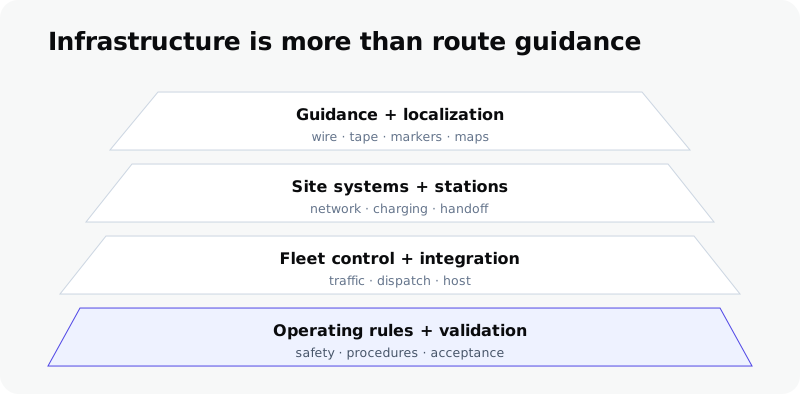
Any layout change can trigger more than a map edit. Traffic behavior, station interfaces, emergency access, risk assessment, operator training, and throughput should be revalidated before the modified system returns to service.
5. Deployment and commissioning
AMRs are often described as faster to deploy, but deployment time depends on the whole system. Mapping may be faster than installing physical guidance, yet the project can still require workflow design, interfaces, charging, network validation, fleet rules, safety assessment, testing, and training.
The same principle applies to AGVs. A simple, controlled route may be straightforward, while a large route network with many intersections and process handoffs can require substantial engineering.
Do not select a technology based on a generic promise of installation in a certain number of days. Build a project plan around the actual site, tasks, interfaces, and acceptance tests.
6. Fleet scaling and traffic management
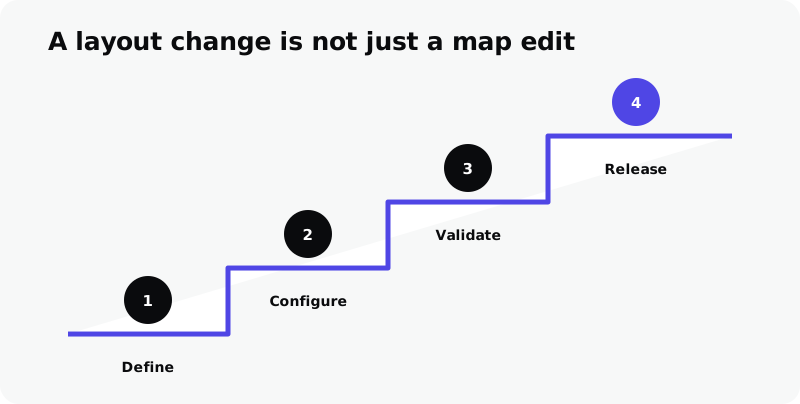
Adding another mobile robot does not necessarily increase throughput in proportion. Larger fleets can create congestion at intersections, queues at stations, charging conflicts, deadlocks, wireless demand, and more complex dispatching decisions.
Both AGV and AMR fleets need task allocation, traffic control, charging logic, fault recovery, and performance monitoring. Simulation or a controlled pilot can help estimate fleet size and identify bottlenecks before full deployment.
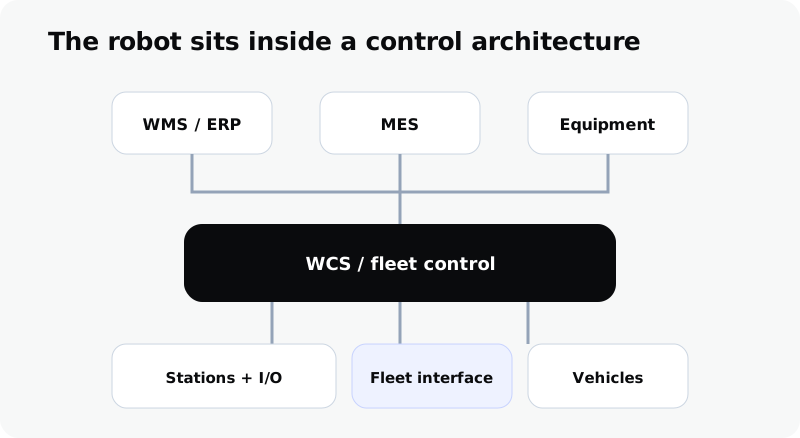
7. WMS, WCS, MES, and ERP integration
The robot is only one part of the material-flow system. A deployment may need to exchange orders, status, inventory events, station signals, alarms, and completion data with warehouse, production, or control software.
VDA 5050 provides a standardized communication interface between a master control system and mobile robots. It can support mixed and multi-vendor fleet strategies when the required versions and capabilities are implemented. It is not a complete WMS or MES integration, and any two products still need engineering and validation before they work together.
8. Payload, throughput, and repeatability
AGV or AMR labels do not determine payload or throughput. Performance depends on the selected vehicle, load-handling method, route length, speed limits, turns, intersections, loading time, unloading time, waiting, charging, task variability, and traffic.
An AGV may deliver highly repeatable flow on a stable route. An AMR may maintain flow more effectively when alternative paths are available. Neither conclusion should be made without comparing equipment under the same task definition and site constraints.
9. Docking, positioning, and load transfer
AGV and AMR labels do not determine docking accuracy or load-transfer performance. A route-following vehicle can still require fine alignment at a conveyor, rack, lift, or machine interface, and an autonomously navigating robot may use markers, sensors, mechanical guides, or a dedicated docking routine for the final approach.
Compare the complete handoff: the vehicle and attachment, station geometry, load dimensions, allowable positioning tolerance, alignment method, communication handshake, exception recovery, and acceptance test. Evaluate the proposed vehicle at the actual station or an equivalent test setup rather than assuming that one category is universally more precise.

10. Safety and standards
Safety must cover the vehicle, control system, load, operating area, human interaction, system integration, maintenance, and changes made after commissioning.
ISO 3691-4:2023 addresses safety requirements for driverless industrial trucks and their systems, including AGVs and AMRs. In the United States, the ANSI/A3 R15.08 series addresses industrial mobile robot safety across the robot, system integration, and user responsibilities.
Sensors, LiDAR, emergency stops, or automatic braking do not by themselves prove compliance. The proposed system still needs project-specific risk assessment, integration review, operating rules, and acceptance testing.
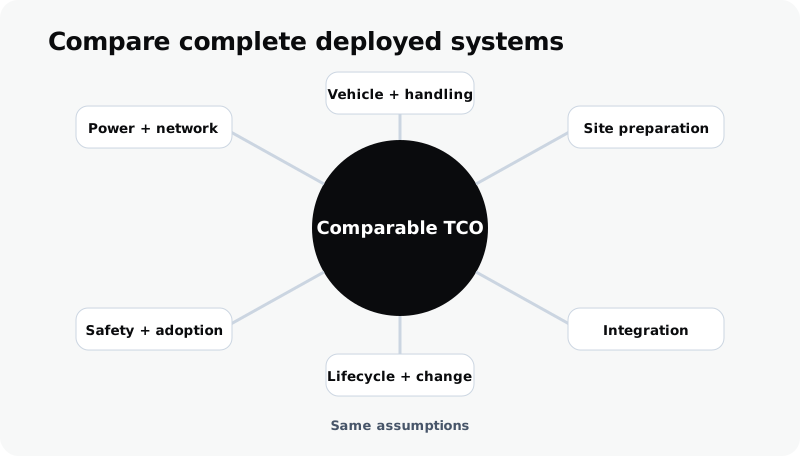
AGV vs AMR cost: compare total cost, not just vehicle price
There is no universal answer to which category costs less. A useful AGV vs AMR cost comparison should use the same task scope and include:
- vehicles and load-handling attachments;
- physical guidance, maps, and site preparation;
- charging equipment and electrical work;
- fleet software and licenses;
- WMS, WCS, MES, ERP, and equipment integration;
- network and cybersecurity requirements;
- safety engineering, validation, and training;
- maintenance, spare parts, support, and downtime;
- manual intervention and exception handling;
- future route, layout, and fleet changes.
ROI should be calculated from an agreed baseline: current labor and equipment costs, actual task volume, expected availability, realistic fleet size, implementation cost, maintenance, and measured operational results. Generic payback claims or vendor case-study numbers should not be applied to a different facility without equivalent assumptions.
AGV vs AMR pros and cons
| Option | Potential advantages | Potential limitations |
|---|---|---|
| AGV | Predictable movement on stable routes; strong fit for repetitive point-to-point flow; route behavior may be easier to standardize in a controlled environment | Route changes may require more engineering or physical work; a blocked fixed path can interrupt flow; expansion may increase route and traffic complexity |
| AMR | Software-led routing changes; dynamic path selection when conditions allow; useful in shared or changing environments | Higher autonomy does not remove the need for site controls; fleet software, mapping, networking, and integration can add complexity; dynamic traffic still needs validation |
These pros and cons only become meaningful when connected to a real task. A feature that adds flexibility in one facility may add unnecessary complexity in another.
Which is better, AGV or AMR?
Choose the system that fits the operating conditions rather than selecting a category first.
An AGV may be a better fit when:
- routes and stations are stable;
- transport tasks are repetitive and predictable;
- the operating area is controlled;
- deterministic route behavior is valuable;
- physical or predefined guidance is acceptable;
- future layout changes are expected to be limited.
An AMR may be a better fit when:
- routes, priorities, or workstations change frequently;
- people and equipment share the same traffic areas and the proposed safety design, traffic rules, and risk assessment support that operating model;
- temporary obstacles are common and alternative routes exist;
- operations need software-led reconfiguration;
- tasks vary by shift, order profile, or production demand;
- phased fleet expansion is expected.
Use this decision sequence
- Define the task: load, handling method, pickup and drop-off points, distance, frequency, cycle time, and peak demand.
- Evaluate the environment: route stability, aisle width, shared traffic, obstacles, floor conditions, and frequency of layout change.
- Define system interfaces: WMS, WCS, MES, ERP, conveyors, doors, lifts, stations, charging, and fleet control.
- Assess risk: people, speed, payload, visibility, restricted areas, exception recovery, and change management.
- Validate performance through simulation, a pilot, or both.
- Compare total cost and expansion effort under the same assumptions.
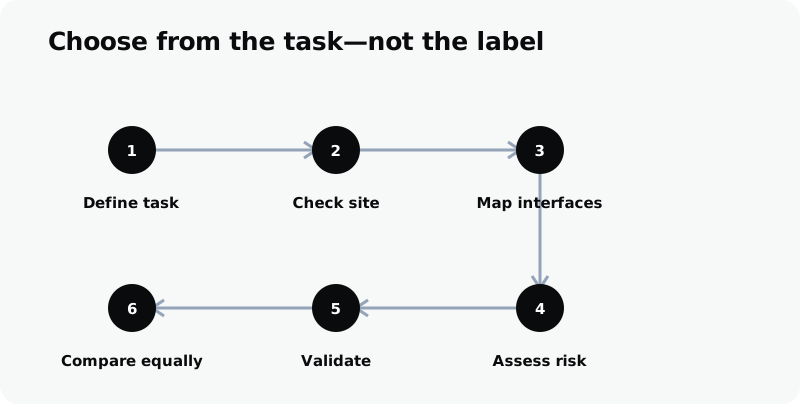
The result may be AGV, AMR, or a mixed fleet. The correct conclusion is “better under these conditions,” not “better in every facility.”
Illustrative scenario: applying the decision framework
The following example is illustrative, not a customer case or a product recommendation.
A facility has one flow that repeatedly moves the same load between two fixed stations through a controlled aisle. Route changes are rare, and deterministic movement is more important than dynamic rerouting. That task may favor an AGV if the proposed vehicle, station interface, safety design, charging plan, and throughput model pass validation.
The same facility also has a second flow whose pickup points change with production demand. People and other equipment share parts of the traffic area, temporary obstructions are common, and alternative routes exist. That task may favor an AMR if its navigation, traffic rules, docking method, integration, and project-specific safety assessment are validated for the real operating environment.
The example does not make either category the facility-wide winner. It shows why the decision should be made flow by flow, using the same task definition, risk criteria, and total-cost scope.

Can AGVs and AMRs work together?
Yes. A facility may assign stable, repetitive flows to AGVs and more variable tasks to AMRs. The challenge is not simply placing both vehicle types in the same building. The project must coordinate traffic, priorities, intersections, charging, stations, host-system orders, fault recovery, and safety rules.
VDA 5050 version 3.0 extends the interface model for mobile robots with different levels of autonomy. It can support a common master-control strategy, but actual interoperability still depends on compatible implementations, supported capabilities, and project-level integration.

Frequently asked questions
Are AGVs and AMRs the same?
Not exactly. Both can be driverless industrial vehicles used for material movement, and terminology can overlap across vendors and industries. In common usage, AGV refers to a system that follows predefined routes, while AMR refers to a system with greater onboard localization and path-planning autonomy.
Is an AGV an AMR?
Not in the usual commercial comparison. They are normally treated as different system approaches. However, both may fall within broader categories such as driverless industrial trucks or mobile robots, and advanced AGVs can use technologies also associated with AMRs.
What is the main difference between AGV and AMR navigation?
An AGV typically follows a predefined path or route network. An AMR typically localizes itself in a map and selects a route through an allowed operating area. The exact behavior depends on the product and fleet-control architecture.
Can an AMR always avoid obstacles?
No. An AMR may reroute when safe clearance, map rules, and alternative paths allow it. It may still need to slow, stop, or wait in narrow aisles, restricted zones, dense traffic, or blocked work areas.
Does an AMR require no infrastructure?
No. It may reduce physical guidance infrastructure, but it still needs mapping, network coverage, stations, charging, fleet rules, safety controls, and system integration.
Is an AGV cheaper than an AMR?
Not necessarily. Vehicle price is only one input. Guidance, installation, software, integration, charging, maintenance, downtime, fleet size, and future layout changes can materially change total cost.
Should I choose an AGV or an AMR?
Choose after defining the task and environment. Stable, repetitive, controlled routes may favor an AGV. Variable tasks, changing layouts, and dynamic traffic may favor an AMR. Validate the choice with equivalent specifications, risk assessment, and realistic performance testing.
Sources
- ISO 3691-4:2023 — Driverless industrial trucks and their systems
- A3 — ANSI/A3 R15.08 industrial mobile robot standards
- MHI — Three Key AGV Functions Controlled by a Variety of Technologies
- MHI — Understanding the Differences Between AGVs and AMRs
- VDA / VDMA — VDA 5050 Version 3.0
- OTTO Motors — Simulating AMRs for Successful Deployments
Ready to evaluate robots?
Tell us what your operation needs, or compare models side by side.