
Quadrupeds for Industrial Inspection: Complete ROI Guide for 2026
When legged robots beat wheels: stairs, grated floors, $80k-$150k cost breakdown, 6-month payback scenarios, and real pilot data from refinery, power plant, and manufacturing inspections.
Factory managers and facility directors keep asking: "Why spend $80,000-$150,000 on a quadruped robot when our wheeled inspection platform works fine for $30,000?" The answer lies not in what quadrupeds can do everywhere—but in the 15-30% of your facility where wheels and tracks physically cannot go.
Where Quadrupeds Win: Terrain That Breaks Other Robots
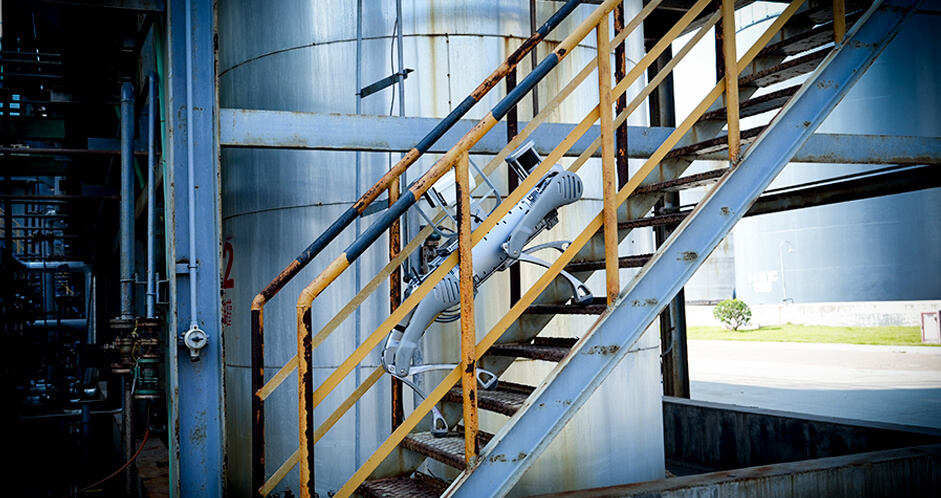
Stairs and Multi-Level Access: Industrial stairs with 30-45° inclines, open-grate metal stairs common in refineries, vertical access between production floors, emergency exit routes requiring periodic inspection. Wheeled alternatives require elevators or human carrying—adding 20-40 minutes per inspection route.
Grated and Perforated Flooring: Cable management walkways with 40-60% void space, cooling tower platforms with drainage grating, elevated catwalks in power plants, offshore platform deck surfaces. Tracked robots get caught; wheels slip through gaps. Quadrupeds treat grating like solid ground.
Cluttered and Obstacle-Dense Zones: Pipe forests with <1-meter clearances, temporary construction barriers and equipment, uneven surfaces from thermal expansion or settling, outdoor perimeter inspection with rocks, roots, and debris. Autonomous navigation works when the environment is static. Quadrupeds adapt when it changes weekly.
Real Pilot Data: What Works vs. Marketing Claims
Refinery Inspection (Texas, 2025-2026): Deployment: 2× Unitree Go2, 48-acre facility with 60% elevated structures. Use case: Daily thermal camera inspection of heat exchangers, weekly visual check of valve banks, gas detection patrol (H₂S, methane). Results: 92% autonomous completion rate, 6.2 hours saved per shift vs. manual inspection, payback in 14 months (labor cost savings), 3 safety incidents avoided (human access to hazardous zones). Challenge: Battery life limited routes to 90 minutes; required 2 swap points.
Power Plant Inspection (Germany, 2026): Deployment: 1× Boston Dynamics Spot with thermal + acoustic sensors. Use case: Turbine hall inspection (noise >95dB environment), boiler tube inspection via stairs, outdoor coal pile perimeter check. Results: 40% faster inspection cycles (2.5 hours → 1.5 hours), detected bearing failure 3 weeks early (acoustic analysis), eliminated confined space entry permits for 80% of checks. Challenge: Dust buildup on sensors required weekly cleaning protocol.
Cost Breakdown: What You Really Pay
Hardware Costs (2026 Pricing): Entry-level quadruped (Unitree Go2): $2,700-$3,500 base unit. Mid-range commercial (Unitree B2): $15,000-$20,000 with SDK access. Industrial-grade (Boston Dynamics Spot): $75,000-$95,000 with support. Heavy-duty (DEEP Robotics X30): $120,000-$150,000 for hazardous environments.
Sensor Payloads (Additional Costs): Thermal camera (FLIR): $8,000-$15,000, LiDAR for mapping: $5,000-$12,000, gas detection suite: $10,000-$18,000, acoustic sensors: $3,000-$6,000. Plus integration labor: $5,000-$20,000 depending on complexity.
Ongoing Operational Costs (Annual): Software licenses and updates: $3,000-$8,000/year, maintenance and spare parts: $6,000-$12,000/year, operator training (2 staff): $4,000-$8,000, insurance (commercial deployment): $2,000-$5,000/year. Total annual operational cost: $15,000-$33,000.
Payback Scenarios: When ROI Makes Sense
Scenario A: Refinery with 500+ Manual Inspection Hours/Month: Baseline cost: 500 hrs × $45/hr (loaded labor) × 12 months = $270,000/year. With quadruped: Reduce to 320 hours (36% reduction), labor savings: $97,200/year, robot total cost (amortized): $35,000/year (hardware + operations). Net savings: $62,200/year. Payback: 18 months.
Scenario B: Manufacturing Plant with Safety/Access Issues: Baseline cost: 4 confined space entries/month × $2,500 (permits + safety team) = $120,000/year, plus 2 incidents/year × $50,000 (avg workers comp + downtime) = $100,000. With quadruped: Eliminate 80% of confined space entries: $96,000 savings, reduce incidents 50%: $50,000 savings, robot total cost: $42,000/year. Net savings: $104,000/year. Payback: 11 months.
When Wheeled/Tracked Robots Are Still Better
Choose wheeled or tracked platforms when: 100% flat surfaces—warehouses, clean rooms, datacenter aisles. Long-distance patrols—quadrupeds tire on 5+ km routes; wheels are more efficient. Heavy payload requirements—need to carry >15 kg of sensors or tools. Budget constraints—sub-$20,000 total spend; quadrupeds start making sense at $50k+ total investment.
Procurement Checklist: Questions to Ask Vendors
Mobility and Durability: Max stair angle and tread width? IP rating for dust/water (IP54 minimum for industrial)? Operating temperature range? Battery runtime under load with YOUR sensor payload? Software and Integration: Autonomous route planning or teleoperation only? API access for custom workflows? ROS compatibility for sensor integration? Cloud vs. on-premise data storage options? Support and Lifecycle: Warranty duration and what it covers? Response time for technical support? Spare parts availability and lead times? Software update frequency and end-of-life policy?
Bottom Line: Strategic Tool, Not Universal Solution
Quadrupeds earn their cost premium in the 15-30% of industrial environments where mobility constraints dominate. If your facility has significant vertical access, grated surfaces, or confined spaces—and inspection labor costs exceed $150,000/year—the ROI math closes in 12-24 months. But don't buy a quadruped to replace a $15,000 wheeled platform doing parking lot patrols. Match the tool to the terrain, validate with a pilot, and build operator workflows before scaling beyond 1-2 units.
Ready to evaluate robots?
Tell us what your operation needs, or compare models side by side.